


The Regional Hub-and-Spoke Solution
NEXUM Energy deploys a highly optimized regional deployment architecture. By combining nimble, field-positioned mobile pyrolysis units in active forest-fire zones with a centralized steam-activation hub, we eliminate the industry’s heaviest transportation bottlenecks while maximizing material value and carbon removal integrity.
The Wildfire Crisis and Feedstock Trapped Value
Unmanaged, low-density forest-fire residues pose an immediate environmental threat. Left on the forest floor, this combustible biomass naturally decomposes—releasing massive quantities of biogenic CO2 and methane—or acts as fuel for subsequent catastrophic fire events. NEXUM intercepts this volatile material loop, converting an ecological hazard into high-performing technical carbon.
Sourcing Footprint: Accessing unmanaged, non-commercial salvage wood across high-risk provincial zones.
Contractual Off-Take: Partnering directly with emergency clearing operators to secure feedstock at a true $0/ton baseline cost.
Carbon Interception: Arresting natural decay emission cycles before volatile elements return to the atmosphere.
Ecosystem Regeneration: Actively removing hazardous fuel loads to support safer, accelerated forest recovery.
Backed by BC’s Wildfire Risk Reduction & Fibre Utilization Programs
NEXUM’s mobile processing units qualify as eligible non-sawlog delivery destinations under the Forest Enhancement Society of BC’s (FESBC) Fibre Utilization and Wildfire Risk Reduction funding streams. This allows forest tenure holders, First Nations, and local governments to access provincial funding to deliver uneconomic, fire-damaged fibre directly to our field units — reinforcing our zero-cost feedstock model with institutional support.
Learn About Funding Alignment$30M Provincial Allocation: FESBC was allocated $30 million (2025–27) to reduce wildfire risk on BC crown land and increase community resiliency.
Eligible Delivery Destination: NEXUM’s containerized units qualify as non-sawlog facilities under the FESBC Fibre Utilization Funding Program.
First Nations Access: First Nations bands and Indigenous-owned entities are priority-eligible FESBC applicants, supporting co-development partnerships.
Wildfire Risk Reduction Synergy: Fibre recovered from FESBC-funded WRR treatments can be channeled directly into NEXUM’s processing pipeline.
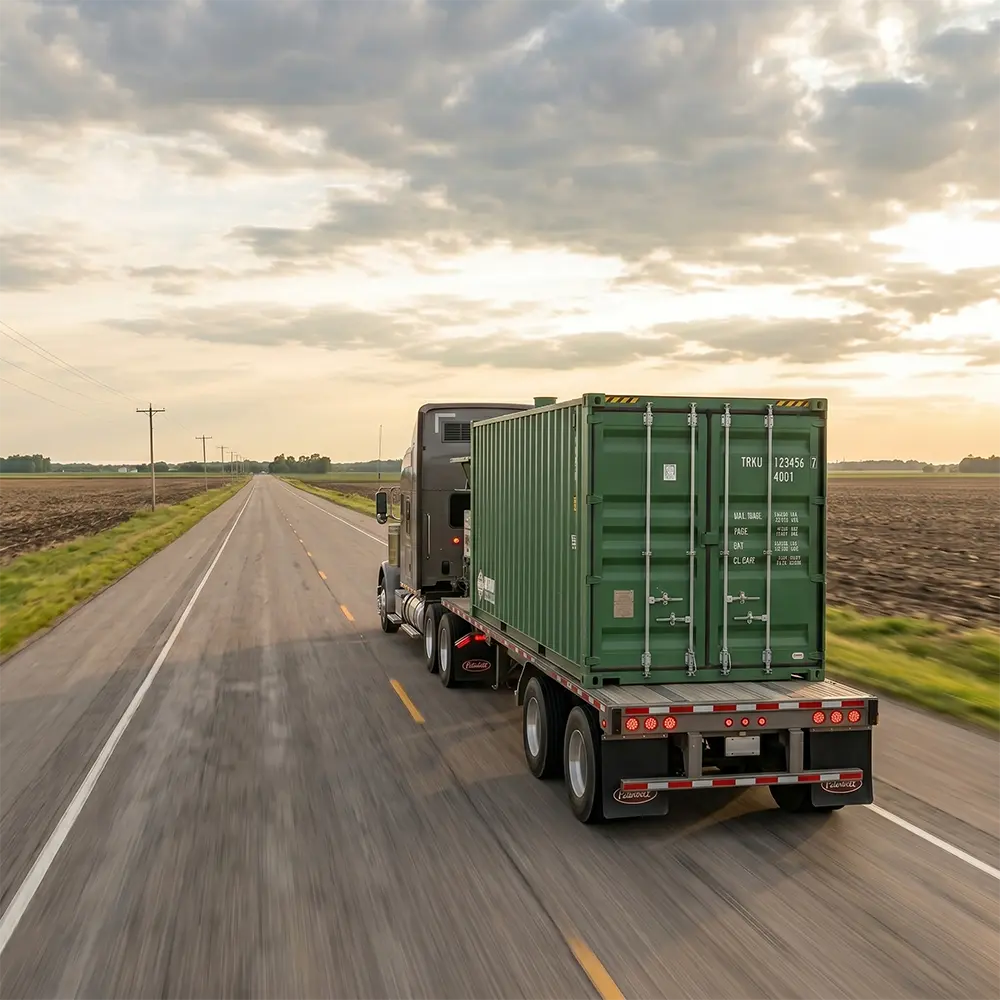
Defeating the Tyranny of Distance in Biomass Logistics
In remote forestry operations, logistics are traditionally the single largest cost driver, regularly swallowing up to 50–70% of total project revenue. Hauling raw, wet biomass over long, rough, and seasonal roads is economically non-viable for low-value commodities. The NEXUM model flips the economic equation completely: our mobile field units slash bulk mass directly at the forest footprint, rendering transportation costs minor and irrelevant to our end-product margins.
The 3-Site Cluster Model
Source Conversion
Containerized, field-ready mobile pyrolysis units deployed directly inside active wildfire cleanup zones.
- Processes 10 tons of raw biomass daily per trailer.
- Drives a rapid 60–75% reduction in total feedstock mass right at the logging site.
- Operates at 400–550°C to transform volatile wood into transport-efficient fixed biochar.
- Eliminates haulage bottlenecks by processing unmanaged material on-site.
Material Value Upgrading
Regional processing centers housing central high-temperature steam activation reactors.
- Runs controlled chemical activation refining at 800–900°C to forge high-surface-area carbons.
- Etches tunable porosity profiles optimized to act as high-demand adsorbents and metal oxide catalyst supports.
- Delivers premium active carriers for transition metal oxides (NiO, CoO, and MoO3) utilized in deep hydrodeoxygenation (HDO) and oil-to-hydrocarbon conversion lines.
Climate Asset Issuance
Integrated cloud-linked tracking systems verifying carbon permanence and logging end-to-end data pipelines.
- Secures complete GPS feedstock traceability from designated forest burn scars.
- Continuous automated logging of reaction heat metrics and residence times.
- Handles comprehensive lab compliance parameters including H/C ratios and iodine numbers.
- Seamlessly issues premium Carbon Removal Credits (CORCs) via Puro.earth and Verra registries.
Shared Central Hub
Chipping, grinding, and material handling equipment shared across all three sites
66%
Project EBITDA Margin
2.1 Years
Capital Investment Payback
$1.075M
Annual Revenue per Cluster
40–55%
Target 5-Year Project IRR
Streamlined Feedstock Preprocessing Specs
Our standardized pre-processing modules prepare raw forest debris for thermal reactors, ensuring high physical homogeneity and moisture stabilization across variable wildfire-salvage inputs.
In-Field Chipping & Screening: Reduces whole logs and brush piles to uniform processing geometry.
Controlled Moisture Tuning: Stabilizes internal water levels to a 15–25% processing standard.
Automated Feed Management: Continuous hopper systems designed for smooth, unmanned reactor intake.
Fluidized Contaminant Removal: Automated ash and stone separating to protect structural reactor loops.
Mass Balance Serialization: Continuous electronic weight scales providing core baseline data for carbon credit calculations.
Closed Utility Integration: Co-located field power frameworks utilizing compact auxiliary generator arrays.
Engineered for Scalable Regional Deployment
Integrated Biorefinery Flexibility: Combining advanced thermochemical processing loops to achieve high resource circularity, seasonal feedstock flexibility, and structural system resilience.
Optimized Energy Returns: Process coupling and self-sustaining syngas recycling optimize our net Energy Return on Investment (EROI), outperforming traditional standalone conversion systems.
Zero-ILUC Feedstock Guardrails: Prioritizing forest residues and salvage waste eliminates carbon debts, water footprints, and land-use competition.
Repeatable Model Replication: Standalone modular units act as independent, highly auditable profit centers designed for smooth institutional scaling and international policy alignment.
 DEPLOYMENT TIMELINE
24-Month Project Lifecycle Execution
Months 1–3: Feedstock Logistics & Regional Sourcing Advisory
Securing regional forest clearance access, executing commercial off-take framework bindings, and finalizing local community alignment protocols.

Months 4–6: Environmental Field Assessment & Permitting
Site qualification audits, process safety clearances, and validation setup for emission monitoring compliance frameworks.
Months 7–9: Modular Assembly & Hardware Procurement
Structural fabrication of trailer-mounted pyrolysis systems and custom high-temperature activation reactor blocks.
Months 10–18: Site Commissioning & Registry Onboarding
Field connection of components, engineering integration testing, and digital dMRV platform synchronization with Puro.earth auditors.
Months 19–24: Steady-State Operations & Scale Optimization
Reaching full nameplate processing throughput, executing continuous material off-take supply contracts, and issuing first-vintage carbon removal validation assets.
Advancing Carbon Permanence through Infrastructure Design.
Our vision is to deploy mobile Active Carbon manufacturing units across Canada, converting millions of tons of wildfire waste into high value active carbon whikle genberating permanent carbon removal credits and shared prosperity with First Nations communities.